Thursday, April 14, 2011

"And on the morrow Justine died."

"And on the morrow Justine died." -- Page 60

What a pleasant way to put it, no?  She was put to death, she didn't just die, but I like the way Mary Shelley thinks.  Straightforward and to the point, unlike the three hours worth of lollygagging preceding it.  However, I did get a lot of helpful information regarding Victor in the chapters leading up to Justine's trial and subsequent "death".  For starters, he's mentally insane.  He believes Justine's innocence even in the face of unquestionable evidence, and when pondering the actions of the daemon, he side notes to Walton that, "[he] did not for a minute doubt" that the creature murdered William.  The creature has consumed his inner thoughts, and he is thoroughly convinced that it is inherently evil and hellbent on murdering people and framing others (makes so much sense, no?) even though he has no substantial proof in this regard.  To contrast this, Victor's longtime friend Henry Clerval represents levelheaded sanity, and serves as a foil character to Victor.  He is open about his thoughts and feelings, unlike Victor, and in his good health tries to console his friend in his time of need, also unlike Victor, who is for the most part in bad health and mopes around his family rather than staying in high spirits for their sakes.  Basically, Victor is nothing like the Frankenstein I imagined (i.e. awesome mad scientist who gets brutally murdered by his creature), but rather a very conflicted bore.

It's Alive!

"It was on a dreary night of November, that I beheld the accomplishment of my toils." -- Page 34


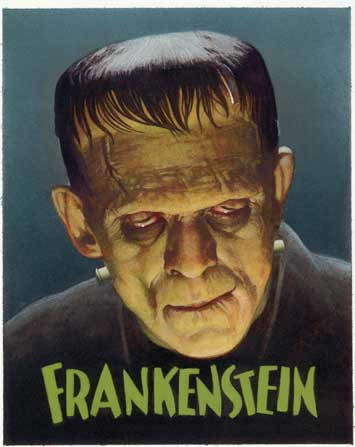
I'm really disappointed by the fact that this classic line isn't in the book.  It makes me upset and I've lost 85% of my respect for Mary Shelley for not thinking of putting it in her novel.  I knew that Frankenstein's monster wasn't called 'Frankenstein', but it's interesting to know that he wasn't ever green, either.  The description of the "daemon" follows:

"I saw the dull yellow eye of the creature open; it breathed hard, and a convulsive motion agitated its limbs...His limbs were in proportion, and I had selected his features as beautiful. Beautiful! —Great God! His yellow skin scarcely covered the work of muscles and arteries beneath, his hair was of a lustrous black, and flowing; his teeth of pearly whiteness; but these luxuriances only formed a more horrid contrast with his watery eyes, that seemed almost of the same colour as the dun-white sockets in which they were set, his shrivelled complexion and straight black lips."

Gross!  Based on this account, I'm thinking Frankenstein looked less like this...


...and more like this:


It doesn't really bother me either way.  I'm still hung up on the "It's alive!" thing...

Veektore Frawnkenshteyen

"I am by birth a Genevese, and my family is one of the most distinguished of that republic..." -- Page 14

And thus begins the tale of Victor Frankenstein, as he tells his story within Walton's own story, a story within a story, a frame story!  The significance of this frame story is the parallelism between the two men.  Both have a deep (albeit questionable) longing for their sisters, and write to them.  Both are hard-driven in their motives and ideals; they both aspire to do something monumental that will benefit mankind, and be the first to do it.  Both men also studied the works of those who preceded them in their prospective fields.  Lastly, both men struggle with doubts and feelings of loneliness.  Basically, they're like the same person.  That's not very original, Mary.  Victor describes his childhood life as pretty perfect, which sucks for him because at current in the novel he hates himself, what he has done, and what he has created.  It's really rather sad, and in a pathetic sort of way I pity Victor.  All he wanted was knowledge, and the knowledge that he sought so desperately has started to destroy him.  What I don't understand is why he's so repulsed by the creature; it hadn't done anything terrific and yet from the start he despised it.  No wonder the thing ran away and went on a killing spree.  All the creature wanted was the approval of his creator, and Victor denied him this.  So I guess I don't really feel sorry for him at all; he brought it upon himself.

SnoozFest 2011

"My affection for my guest increases every day." -- Page 11

Alright, I'm almost halfway through reading Frankenstein, and all my mind is allowing me to think right now is how unbearably whiny every male figure in this book is.  Robert Walton and Victor Frankenstein, our two narrators thus far, are self-pitying effeminates who both desire to be with their sisters.  Really, Mary Shelley was one messed up 18 year old.  For much of the beginning letters, Walton complains about either a) not having any friends, or b) his own doubts and general bi-polar confidence levels concerning his mission.  Then, by the grace of God, he finds a new character (and can stop talking about himself for once) in the near-dead Victor Frankenstein.  Unfortunately for me, the reader, Victor takes the opportunity to bore us all with a lengthy amount of exposition in four more chapters of slow, painful development of his background while simultaneously creeping us all out with his yet-to-be-realized-but-really-it's-there-he-just-isn't-coming-straight-out-and-saying-it love for his "cousin".  For the rest of the time, he's complaining about how awful his fate is and how he just can't take living this terrible, horrible, no good, very bad destiny he's created for himself.  I don't feel any sympathy for him though; he's delusional and he brought this upon himself.  That's what you get when you dabble in the black magic!  I feel like so far there's not a whole lot to figure out, because most of the text is straightforward and I don't know enough yet to analyze in depth.

Wednesday, April 6, 2011

I Wanna Go Play BioShock Now

"He gazed up at the enormous face. Forty years it had taken him to learn what kind of smile was hidden beneath the dark moustache. O cruel, needless misunderstanding! O stubborn, self-willed exile from the loving breast! Two gin-scented tears trickled down the sides of his nose. But it was all right, everything was all right, the struggle was finished. He had won the victory over himself. He loved Big Brother." -- Page 266

I really, really, really, really, really, really, really, really, really, really, really, really, really, really, really, really, really, really, really liked 1984 (by George Orwell).  The more that time passes since I've finished reading it, the more I find myself enjoying everything about it.  Sure, it takes a little while to pick up a pace, and sure, most of the conflict is internal, and sure, it's all a bunch of political philosophies tied up in jargon within Winston's chaotic brain and O'Brien's bold statements and the Party's haunting aphorisms and the Book, but what can I say, I like that stuff.  I would like to think that Orwell's vision hasn't come true, but sometimes the amount of information documented of individuals and filed out there is scary to think about.  However, while having a discussion with a scholarly friend over Spring Break about 1984, we both agreed that a society such as the one Winston Smith lives in during the novel is unrealistic in today's world, mostly because of the obsessive use of the Internet.  With so much information able to be uploaded, processed, shared, downloaded, and synthesized so rapidly anywhere on the globe, a society where the populace is entirely closed off from the outside world is unthinkable.  Oceania relied on lies about the wars and the destruction of excess goods through continuous warfare to keep its citizens in the dark, and this would be virtually impossible in today's world because of the Internet.  Recently in the Middle East, the suppressed classes have revolted against their governments, and these revolutions in short were made possible because of networking sites that exist today like Facebook, Youtube, and Twitter, none of which were even conceptualized ten years ago.  Orwell could not have foreseen the Internet when writing 1984, let alone the thought of mass social networking.  On the same thread, websites like WikiLeaks, founded by Julian Assange, will reveal ridiculous amounts of information that governments keep from its people.  Documents that aren't even withheld for power-hungry reasons, as in 1984, but for issues of national security.  Because of the inconceivable power and capacity of the Internet, and, I think, because of the existence of the book 1984 itself, George Orwell's vision of the future, at least at present, is in no danger of eventuation.